
Ebola Outbreak in 2026:Could The World Face Another Pandemic?
Where We Are Right Now
As of May 27, 2026, an outbreak of Ebola disease caused by the Bundibugyo virus is still actively extending in the Democratic Republic of the Congo (DRC) and Uganda, with high numbers of confirmed and suspected cases and deaths being reported. The DRC has reported a total of 121 confirmed cases, including 17 deaths, and 1,077 suspected cases, altogether 238 deaths, across Ituri, North Kivu, and South Kivu provinces. Uganda has reported seven confirmed cases, including one death. Three out of seven confirmed cases are linked to travel from DRC.
This is the 17th Ebola disease outbreak in the DRC since 1976. A critical four-week gap between the onset of symptoms of the presumed index case on April 25, 2026, and laboratory confirmation of the outbreak on May 14 suggests that healthcare providers had a low clinical suspicion of Ebola, partly because other co-circulating illnesses like arboviruses and influenza masked the early warning signs.
The WHO Director-General Tedros Adhanom Ghebreyesus has warned that eastern DRC faces a “catastrophic collision of disease and conflict,” with insecurity, attacks on health facilities, and population movements making it “nearly impossible” to trace contacts and isolate cases. “We cannot build community trust or isolate the sick while bombs are falling,” he said.
On May 22, the WHO upgraded its risk level for Ebola in the DRC to “very high,” while its regional risk remained “high” and its global risk remained low.
A Brief History of Ebola: From the Ebola River to the World’s Attention
Ebola disease was first identified in 1976 after an outbreak in what is now the Democratic Republic of Congo. Since then, the virus has emerged periodically from an animal reservoir that remains not fully understood, infecting people across several African countries.
In 1976, the first outbreak (Ebola-Sudan) infected over 284 people with a mortality rate of 53%. A few months later, a second strain emerged from Yambuku, Zaire-Ebola-Zaire-with the highest mortality rate of any Ebola virus at 88%, infecting 318 people.
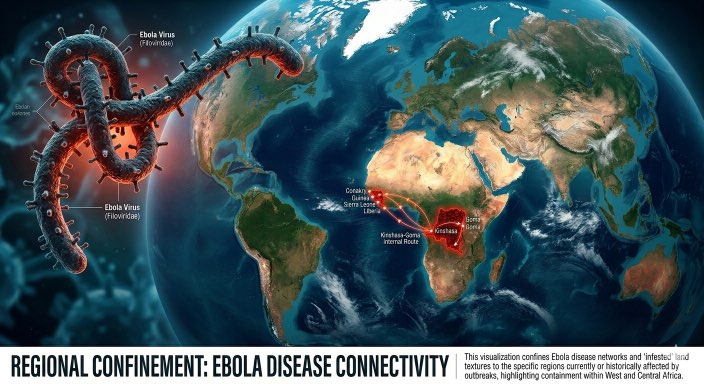
The 2014–2016 Ebola virus disease outbreak in West Africa was the largest and most complex outbreak since the virus was first discovered in 1976, with more cases and deaths than all other outbreaks combined. It spread between countries, starting in Guinea and crossing land borders to Sierra Leone and Liberia.
A meta-analysis of global Ebola data from 1976 to 2022, covering 42 outbreaks across 16 countries, found that the pooled case fatality rate (CFR) across all strains was 60.6%. The Zaire strain was the most lethal with a CFR of 66.6%, followed by Sudan at 48.5%, and Bundibugyo at 32.8%.
The DRC has now seen 17 outbreaks across five decades. The resurgence of outbreaks has accelerated: nine out of the last 16 outbreaks occurred during the last 16 years alone. Each time the world thought it had Ebola cornered, the virus found a way back.
What Makes the 2026 Outbreak Different?
The current outbreak is not caused by the Zaire Ebola strain, which most people associate with the disease. This outbreak is driven by the Bundibugyo virus, a cause of deadly Ebola disease last seen in a major outbreak more than a decade ago. Bundibugyo was first identified in 2007 after an outbreak in the Bundibugyo District of western Uganda, near the DRC border. A second outbreak followed in DRC’s Province Orientale in 2012, with 59 cases and 34 deaths. The case fatality rate in those previous outbreaks ranged from 30% to 50%.
Vaccines and treatments now exist for the Zaire strain, which drove the 2014–2016 epidemic and the 2018–2020 outbreak in DRC, both of which ultimately spurred major scientific advances. But for the Bundibugyo virus, no vaccine or treatment has been approved so far.
The Ebola vaccine licensed in the United States (ERVEBO®) is indicated only for the Zaire strain. Based on animal studies, this vaccine is not expected to protect against Bundibugyo virus. There is currently no FDA-approved or authorized treatment for Bundibugyo virus disease (BVD), though therapies that have shown some efficacy in animal models exist, and with intensive supportive care and fluid replacement, mortality rates may be lowered.
This is the fundamental problem the world is dealing with in 2026: a fast-moving, under-detected outbreak, in a conflict zone, caused by a virus strain for which there is no medical weapon ready to deploy.
Could This Reach Other Continents? What Are the Real Odds?
This is the question most people outside Africa are quietly asking, and it deserves an honest answer.
On May 17, 2026, WHO determined that the outbreak constitutes a Public Health Emergency of International Concern (PHEIC), but does not meet the criteria of a pandemic emergency as defined under the International Health Regulations. The high positivity rate of initial samples, the confirmation of cases in Kampala, and increasing trends in syndromic reporting all point toward a potentially much larger outbreak than what is currently being detected with significant local and regional risk of spread.
Health experts emphasize that while the outbreak is alarming, it is unlikely to trigger a pandemic. “The PHEIC is WHO’s way of saying it’s likely not going to stay inside the DRC and Uganda,” according to infectious disease specialists. However, the outbreak is at the WHO’s highest level of alarm without being a pandemic.
The European Centre for Disease Prevention and Control (ECDC) assesses the infection risk for people living in the EU and EEA to be very low. This is due to the virus requiring direct contact with a symptomatic patient’s body fluids, and the low likelihood of importation and secondary transmission in Europe.
The U.S. CDC similarly considers the risk of spread to the United States to be low at this time. However, it is possible for travelers from affected areas in DRC or Uganda to enter the United States, which is why CDC is working to raise awareness among travelers, public health departments, laboratories, and healthcare workers.
That said, the risk is not zero. According to public health experts at Johns Hopkins, “Could there be other people who are exposed, become infected, and end up somewhere else? It’s possible.” This is precisely why affected countries have started screening all passengers leaving the country, and this screening goes beyond checking for symptoms to also checking for possible exposure.
Outbreaks that begin in the most remote parts of the world can now spread swiftly to urban centers and countries far away. Population mobility across borders played a critical role in the spread of Ebola virus in West Africa during the 2013–2016 epidemic. A more recent example is the 2016 yellow fever outbreak in Angola, where infected travelers from Angola reached China representing the first ever reported cases of yellow fever in Asia.
The 2026 outbreak does have one factor making international spread more plausible than past DRC outbreaks: it has already reached a capital city. As of May 27, 2026, five cases related to the DRC outbreak have been reported in Uganda’s capital, Kampala. An American doctor working in the DRC tested positive for Ebola on May 17 and is being moved out of DRC for care. Capital cities have international airports. International airports connect continents.
Is a Global Pandemic Possible?
Bluntly put: a full-scale Ebola pandemic on the scale of COVID-19 is unlikely, for biological reasons. The Bundibugyo virus spreads through direct contact with bodily fluids, a person can only become infected if their broken skin or mucous membranes come in contact with an infected person’s blood, urine, saliva, or other bodily fluids, or contaminated objects. It does not spread through the air. It is not like measles or COVID-19.
Despite its high lethality, the Ebola virus survives little more than 30 seconds outside a bodily fluid, and infection rates are considerably lower than for other diseases. In high-income countries with functional hospital infection control, a single imported case is unlikely to spark widespread secondary transmission unlike what happened in West Africa, where healthcare infrastructure was overwhelmed.
But none of this means the world can be complacent. The 2014–2016 outbreak taught a painful lesson about what happens when the international community waits too long to act. And the current situation has several factors compounding risk: a delayed initial detection, an active conflict zone preventing contact tracing, a strain with no vaccine, and cases already confirmed in a second country’s capital.
What Needs to Happen Now?
WHO Director-General Tedros acknowledged on May 25, 2026, that “the epidemic is outpacing us,” and laid out the immediate priorities. WHO has recommended advancing two monoclonal antibodies into clinical trials and is also recommending evaluation of the antiviral obeldesivir as post-exposure prophylaxis for high-risk contacts. WHO has released US$3.9 million from its Contingency Fund for Emergencies.
In the absence of approved treatments and vaccines, the response currently relies on a combination of core public health measures: early isolation of suspected and confirmed cases; daily monitoring of contacts over 21 days with immediate quarantine at symptom onset; strict infection prevention and control protocols including hand hygiene, waste management, and personal protective equipment for healthcare workers; safe and dignified burials to prevent transmission during funeral rituals; and on-the-ground epidemiological work to reconstruct transmission chains.
The EU’s Health Security Committee issued guidance on May 22 covering precautionary measures and exit screening recommendations. The EU has also contributed €7.4 million to a WHO research and development blueprint aimed at fast-tracking clinical trials for Bundibugyo-specific countermeasures.
For people in other continents, the most important actions are not panic-driven, they are practical: healthcare workers in all countries should be briefed on Bundibugyo virus disease symptoms and risk factors; hospitals should have updated protocols for isolating patients with travel history to DRC or Uganda who present with hemorrhagic fever symptoms; and border health screening at international airports needs to remain active and thorough.
The Bigger Picture
Ebola keeps coming back, not because we lack knowledge, but because we keep failing to invest in the conditions that prevent outbreaks: functional health systems in endemic regions, rapid diagnostic infrastructure, surveillance networks that can catch unusual mortality clusters within days rather than weeks, and a scientific pipeline that doesn’t ignore rare pathogens until they’re already killing hundreds.
This is the 17th Ebola disease outbreak DRC has experienced since 1976, and the third involving the Bundibugyo virus, yet it is a strain for which no vaccine or treatment has ever been approved. That is not a failure of science alone. It is a failure of global health financing and political priority.
The good news is that Ebola, for all its horror, has never triggered a global pandemic. The bad news is that the 2026 outbreak is testing the limits of what containment looks like when a novel viral strain meets a war zone, and when the world’s medical toolkit has a critical gap in it. The outcome of the next few weeks in DRC and Uganda will say a great deal about whether the global health system has learned anything from the past fifty years.
Bibliography
· WHO Disease Outbreak News (May 2026),
· ECDC Threat Assessment Brief (May 2026),
· U.S. CDC Health Alert Network (May 2026),
· European Commission Health Security Committee (May 2026),
· Doctors Without Borders/MSF (May 2026),
· Johns Hopkins Bloomberg School of Public Health (May 2026),
· Gavi Vaccine Alliance (May 2026),
· Scientific American (May 2026),
· UN News (May 2026),
· ScienceDirect meta-analysis on Ebola CFR 1976–2022.

Prof. Adhikari is a public health researcher and academician with over 17 years of experience in non-communicable diseases, health systems strengthening, and evidence-based interventions. Holds a PhD and MPH, with 50+ peer-reviewed publications and editorial roles in PubMed-indexed journals. His articles often focus on digital health tools, preventive care, mental health, and community-based strategies to improve global health outcomes through policy and practice.